
Circular design is becoming increasingly influential in how property decisions are made. At its core, circularity is about keeping materials in use for as long as possible, which means designing spaces so components can be repaired, reused, reconfigured or recovered instead of discarded.
At Workable, we see this shift being driven not by ideology, but by very real pressures: rising material demand, embodied emissions, and growing expectations that buildings should evolve without unnecessary waste. Circularity gives us a practical way to do that. Government settings are already signalling this direction. The shift is clear and circularity is the practical way to deliver on it.
Circular Economy vs. Linear Economy – what is the difference?
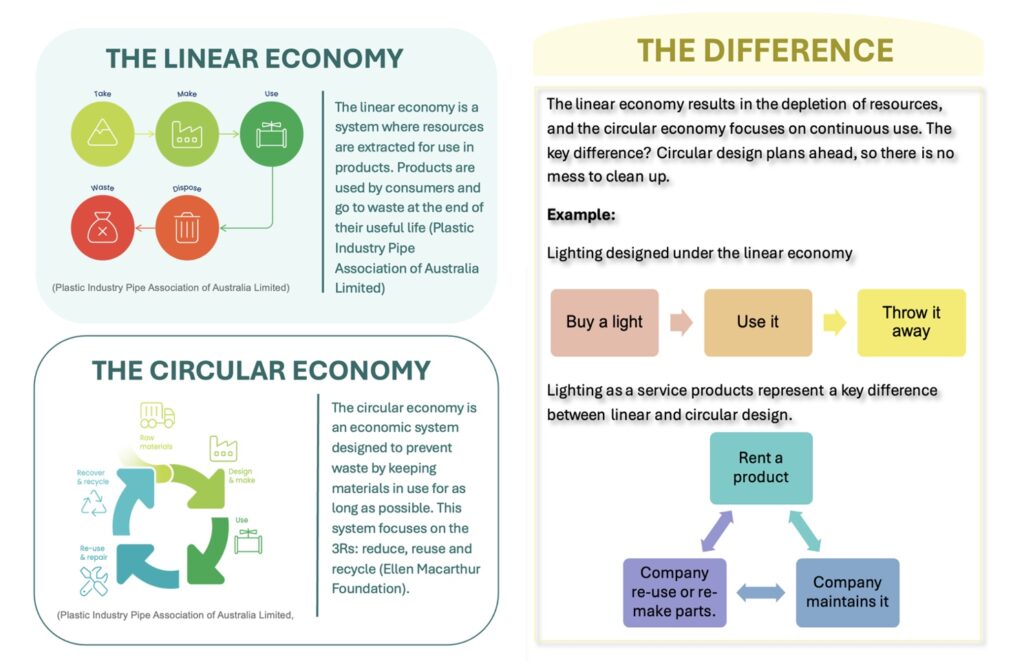
Understanding circular design starts with understanding the system it replaces. Most products today are created through a linear model that moves from taking resources to making products to eventually throwing them away. It is a system that delivers convenience at the expense of long-term value. Circular design flips that logic. Instead of planning for waste, it plans for continual use, repair, recovery and renewal. The diagram below shows the difference in the simplest possible terms.
The shift toward circularity is unavoidable.
Australia’s transition toward a Net Zero and circular economy is also reshaping what “good” looks like in the built environment. The United Nations International Resource Panel highlights in its Global Resources Outlook update that construction is responsible for roughly 50% of material extraction and nearly 40% of energy-related emissions. When a sector has that level of impact, it naturally attracts higher expectations, and those expectations are now showing up in policy.
The broader context behind the shift toward circularity is simple: the traditional “take, make, use, dispose” model is no longer compatible with the physical limits of the world we operate in. Global material demand continues to rise, yet the supply of new resources and the capacity of natural systems to absorb waste are not keeping pace. Research undertaken at the Ellen MacArthur Foundation states that the world is already consuming resources at a rate far beyond what the planet can regenerate, and construction remains one of the most material-intensive sectors driving this imbalance.
There is also a global commitment to fix this problem before it becomes unmanageable. Long-modelling presented by the International Resource Panel indicates that if the world continues on a linear trajectory, global consumption in 2050 is projected to be more than three times what the planet can sustain. SDG 12 (Responsible Consumption and Production) is designed to prevent exactly that, calling for substantial reductions in waste by 2030 through prevention, reduction, recycling and reuse.
However, Australia is not yet on track. As shown in the image below, the SDG Dashboard puts us firmly in the red for SDG 12. While the trend line is improving, major challenges remain. For a sector that moves vast volumes of materials through construction, refurbishment and fit-out cycles, the property industry has a significant role to play in shifting that trajectory.
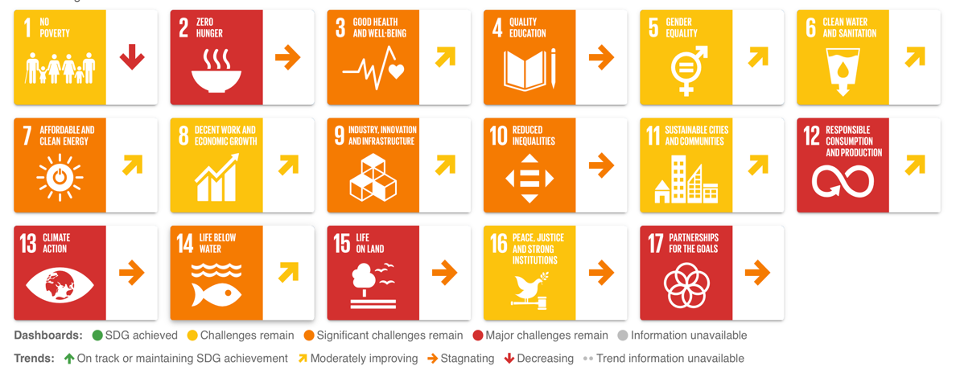
(United Nations Sustainable Development Goals, Dashboard for Australia’s progress).
A circular economy responds to this challenge by keeping materials in productive use for as long as possible. In property terms, this means designing spaces that can adapt, reconfigure and renew without demolition becoming the default. It means thinking about assembly, maintenance and recovery long before anything arrives on site.
Some of the most effective circular approaches include:
- Modular, adaptable components
- Service-based models (lighting-as-a-service, furniture-as-a-service)
- Portfolio standardisation so materials can move, not be discarded
- Take-back schemes for ICT, flooring, lighting and furniture
- Designing for change so workplace evolution doesn’t equal waste
These strategies keep materials in circulation, reduce environmental impact and strip out a lot of the churn that normally drives refurbishment cost.
And it all comes back to early decisions. Most embodied carbon is locked in before a building ever opens. Every refurb either deepens that footprint or corrects its course. Circular design shifts that course toward lower waste, lower emissions and more adaptable assets.
Rethinking waste: why circularity is quietly redefining property and the rules that govern it.
The policy environment that governs the way property decisions are made in the Commonwealth is clearly moving in a direction of strong sustainability. Government property is no longer ‘encouraged’ to think about circularity, it is increasingly becoming embedded in the rules, strategies and frameworks that guide how assets are planned and procured.
Government property operates within a clear framework: value for money across the whole life of an asset. This sits at the centre of the Commonwealth Property Management Framework (CPMF) and has long included the costs associated with construction, operation, maintenance and disposal. However, the broader environment around these decisions is evolving. Australia’s nationally determined contribution under the Paris Agreement, the APS Net Zero Roadmap, the Net Zero in Government Operations (NZGO) Strategy and the Environmentally Sustainable Procurement Policy (ESP) each bring a stronger focus to how materials are sourced, used and recovered. Each element of the policy framework plays a distinct role:
- The APS Net Zero Roadmap sets the overall direction for how the Commonwealth meets its national commitments.
- The NZGO Strategy defines what a net zero-ready asset looks like and includes the requirement to achieve and maintain performance under Green Star and NABERS, both of which increasingly reward adaptability, reuse and material stewardship.
- The ESP Policy brings lifecycle thinking into procurement, placing weight on durability, repairability, reuse potential, recycled content and credible end-of-life pathways.
While every policy or strategy carries its own intent and requirements, they collectively point toward the same outcome: a property system that makes better use of resources, avoids unnecessary waste and supports a more resilient, sustainable future. Circularity isn’t just consistent with this direction; it is embedded within it.
Circular design creates stronger financial, operational and market outcomes.
Circular design pays off and not in small ways. Materials that can be repaired, reused or reconfigured cost less to replace. Modular systems create adjustable fit-outs that are easier to adjust and service-based models shift maintenance back to the supplier, often delivering better products and fewer surprises.
And in the government property world, these benefits show up quickly.
For Commonwealth tenants, circularity reduces environmental impact and aligns neatly with the ESP Policy and the NZGO Strategy. It also demonstrates strong stewardship, which increasingly matters when procurement, sustainability and operational performance converge.
Landlords feel the upside too. Buildings with circular systems are easier to refresh between tenancies. Spaces can adapt without demolition. Costs become more predictable. These buildings also perform better under Green Star, which makes them more competitive for government leasing. And as the Commonwealth National Lease points toward no make-good for Commonwealth tenants, the ability to reuse, reconfigure or recover materials becomes more than a nice-to-have.
In simple terms: circular design makes assets cheaper to run, easier to maintain and better positioned in a market that’s shifting away from consumption and toward accountability. It’s good sustainability and good business.
A smarter future for the built environment
Circular design should be something that we’re all thinking about in our design, in our procurements and in our day-to-day thinking. Clear opportunities exist to embed circularity into design briefs and project scopes, particularly by selecting modular components, designing for disassembly and working with suppliers who provide credible stewardship and recovery pathways. Service-based models for lighting, furniture or equipment offer immediate reductions in waste and maintenance burden. Material and system standardisation across portfolios simplifies procurement, reduces duplication and improves reusability.
What’s encouraging is that none of this relies on radical new technology or untested ideas. These are practical steps that reduce cost, lift performance and strengthen the long-term value of the assets already in play. Green Star and NABERS are beginning to reward these choices, policy is pointing in the same direction, and market expectations are shifting with it.
And you can already see that shift on the ground. Materials are being kept in circulation instead of thrown away. Organisations are starting to invest in systems that are designed to last and adjust over time. It is a quiet shift, but it is a meaningful one.
The NZGO Strategy, the APS Net Zero Roadmap, the ESP Policy and the rating tools that sit alongside them are already shaping a future where material stewardship matters. The question is no longer whether embodied impacts should be considered. The question is how quickly we integrate the solutions that are already in front of us. Circular design is one of those solutions and it is available right now.
As circular design becomes increasingly embedded in how buildings are planned, delivered and renewed, the opportunity is simple: choose the options that give your assets a longer life. It’s practical, it’s future-proof, and it’s a far smart way to run property.